
VINCIVARO.AI

Supreme Court India

Blog

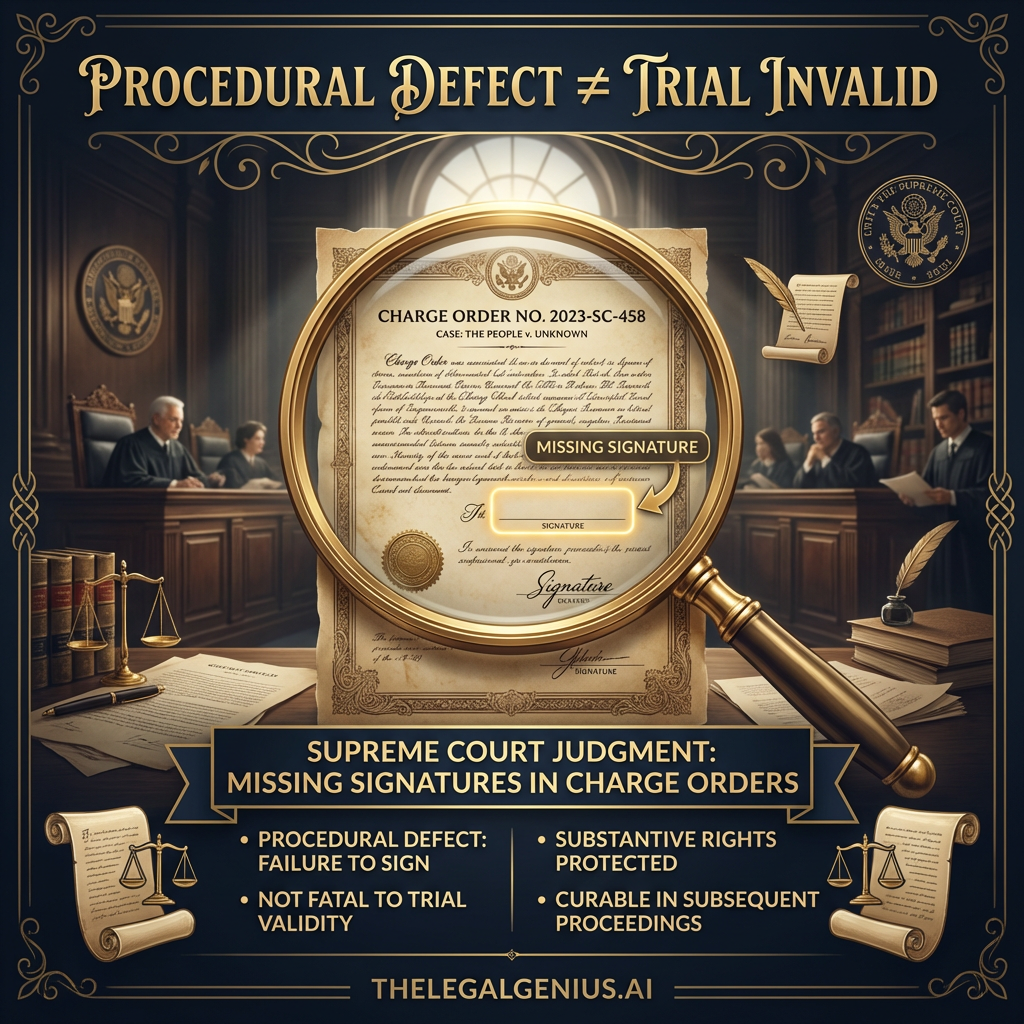
Missing signature charge order Supreme Court

Introduction The Supreme Court of India has clarified an important issue in criminal trials. It held that a missing signature on a charge-framing order sheet is a curable procedural defect. This means the trial does not become invalid just because the judge did not sign the order. This ruling gives much-needed clarity on how courts should deal with technical errors. What is the Issue of Missing Signature in Charge Order? In many criminal cases, lawyers raise objections about unsigned documents. One common issue is the missing signature on the charge order sheet. The charge order is important because it tells the accused what charges they face. It is a key step under the Code of Criminal Procedure. However, the Supreme Court has now made it clear that a missing signature alone is not enough to cancel a trial. Supreme Court’s View on Curable Defect The Court explained that a missing signature is a procedural irregularity, not a serious legal error. It becomes important only if it affects the rights of the accused. The Court focused on one key question: 👉 Did the missing signature cause any real harm? If the answer is no, then the defect can be corrected. The trial remains valid. When Does a Missing Signature Matter? A missing signature on a charge order may matter only in certain situations: If none of these issues exist, the trial will not be affected. Why This Judgment is Important This ruling is important for the legal system. It prevents unnecessary delays in criminal trials. Earlier, small procedural mistakes were often used to challenge cases. This led to delays and retrials. Now, the Court has limited such arguments. The judgment supports a simple idea: 👉 Justice should not fail because of minor technical defects Impact on Lawyers and Legal Practice This decision changes how lawyers approach procedural errors. Now, it is not enough to point out a mistake. Lawyers must show how the mistake caused actual harm. This will lead to stronger and more meaningful legal arguments. Role of Legal Research Platforms Understanding such rulings is important for legal professionals. Platforms like VINCIVARO.AI help users stay updated with the latest judgments. They also help in analyzing whether a defect is procedural or serious. This makes legal research faster and more effective. Conclusion The Supreme Court has made it clear that a missing signature on a charge order is not a fatal error. It is a curable defect. As long as the accused understands the charges and faces no prejudice, the trial remains valid. This ruling strengthens the idea that substance matters more than procedure. It ensures that justice is not delayed due to minor technical issues.
Blog

What is an “Industry” and Why It Matters

On March 17, 2026, the Supreme Court of India began hearing a key question—what is an “industry”? At first, this may sound simple. However, in India, this one word can affect millions of workers and businesses. A nine-judge Constitution Bench, led by Surya Kant, is deciding how the term should be understood under the Industrial Disputes Act, 1947. Therefore, the outcome of this case can change how labour laws apply across the country. Why the Definition of Industry is Important The meaning of “industry” decides who gets protection under labour laws. If an organization is treated as an industry, workers get legal rights. For example, they can raise disputes, ask for fair wages, and demand better working conditions. On the other hand, if an organization is not considered an industry, these protections may not apply. As a result, many workers may be left without support or legal remedies. The Balance Between Workers and Businesses This is why the case matters so much. A broader definition can include more organizations. In that case, more workers will receive legal protection. This can improve job security and working conditions. However, a narrower definition can reduce the burden on businesses. It can make compliance easier and help companies operate smoothly. So, the Court must find a balance. It needs to protect workers while also supporting business growth. Why This Issue Has Been Confusing Over the years, courts have given different views on what counts as an industry. Some decisions expanded the meaning, while others tried to limit it. Because of this, there is still confusion in the law. At the same time, the economy has changed. Today, many people work in services, startups, and digital platforms. These new types of work were not common when the law was first created. Therefore, old definitions may not fit today’s reality. How This Decision Can Impact the Future This hearing can bring clarity. It can set a clear rule for the future. As a result, both workers and businesses will better understand their rights and duties. The decision will affect many sectors. For instance, it can change how companies manage employees. It can also affect how workers raise complaints. In addition, it may impact contracts, working conditions, and dispute resolution. For workers, this case is about fairness and protection. For businesses, it is about clarity and ease of compliance. Final Thoughs The Court is not just deciding a word. Instead, it is shaping the future of labour law in India. Its decision will influence how laws apply to modern industries and new types of work. At VINCIVARO.AI, we believe legal updates should be simple and easy to understand. Laws like the Industrial Disputes Act affect daily work life. Therefore, people should know how these changes impact them. The case is still ongoing. However, one thing is clear. The final decision will have a long-term impact. It will define how India balances worker rights and business growth in the years to come.

Scroll to Top